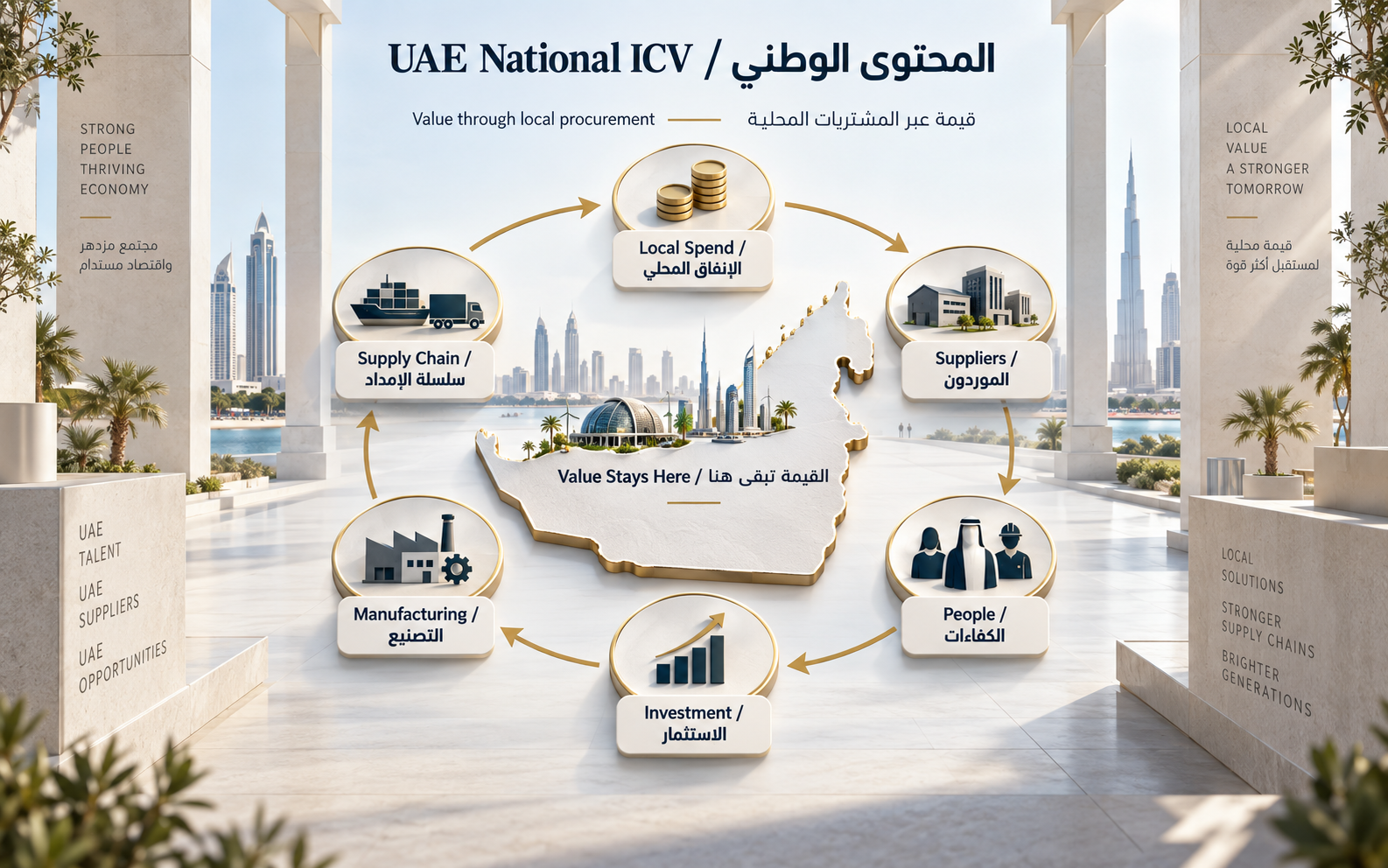
In-Country Value is not only a certificate attached to a tender. It is a way to understand how much value a company leaves inside the UAE economy through its spend, suppliers, people, investments, and supply-chain choices.
“The question is no longer only who offers the lowest price. It is which procurement decision keeps value in the country, develops suppliers, strengthens the economy, and remains commercially sound.”
1. What Is In-Country Value?
In the UAE context, ICV measures a company’s contribution to the local economy. It looks beyond contract value and asks where spend goes, how much value remains in the country, and how the company supports sustainable local capability.
Important context: ICV began in Abu Dhabi through ADNOC’s program in 2018, but the current National ICV Program is a UAE federal initiative supervised by the Ministry of Industry and Advanced Technology. It should not be presented as Abu Dhabi-only.
2. Why Does It Matter?
For suppliers, ICV can influence competitiveness in government, semi-government, and large national-company opportunities. For procurement teams, it is a tool for aligning spend with institutional and national priorities without reducing the decision to one score.
3. Certification and Measurement
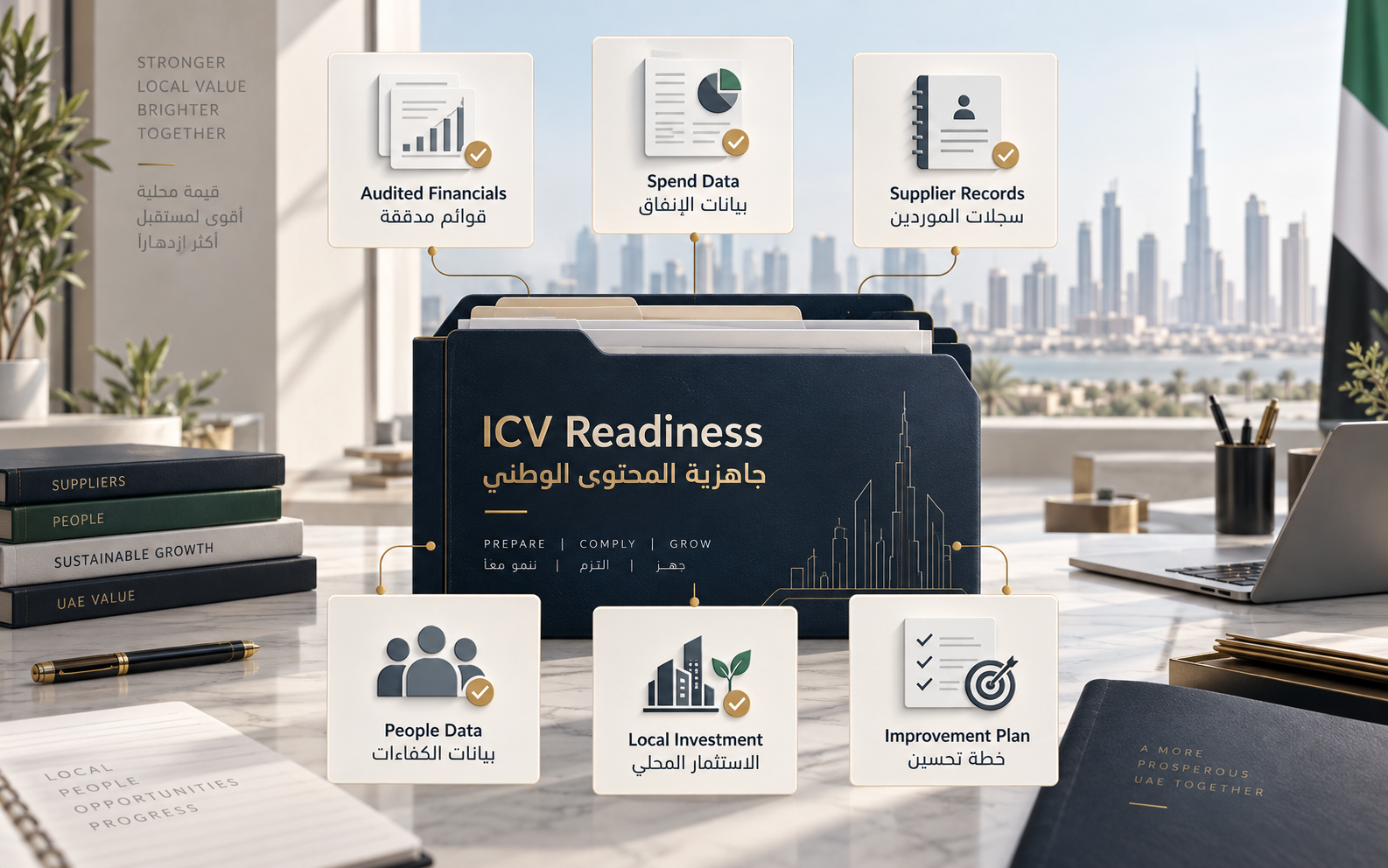
ICV certification requires reliable financial and operational data. Suppliers should treat it as a discipline of data quality, governance, and improvement rather than a last-minute administrative step.
4. Tenders and Award Decisions
ICV should be designed carefully within tender evaluation. It does not replace price, technical quality, delivery capability, or risk review. It becomes strongest when it is balanced with the nature of the category and the maturity of the market.

5. Supplier Readiness
Readiness starts before certification. Suppliers need to understand their spend structure, classify suppliers, prepare financial documents, and identify realistic ways to increase local value through sourcing, partnerships, manufacturing, or employment.
6. Procurement’s Role
Procurement should translate ICV objectives into practical sourcing decisions: where local suppliers make sense, where knowledge transfer matters, where local alternatives reduce risk, and where global competition remains necessary.
7. Local Spend and Supply Chains
Tracking local spend helps organizations understand whether value is leaving the economy unnecessarily, and whether a stronger local supply chain can be built while maintaining quality, cost, competition, and continuity.
8. Local Manufacturing and National Products
Clear demand signals from large buyers can encourage suppliers and manufacturers to invest in local capability. Long-term contracts, future purchase agreements, and supplier development plans can make that investment more realistic.
9. Emiratisation and Skills
ICV also connects to private-sector employment and national skills. Service and project contracts can include training, knowledge transfer, and measurable capability-building obligations.
10. Technology and Sustainability
Local value is not only about buying locally. It can also support productivity, digital maturity, sustainability, energy efficiency, better data, and more transparent supply chains.
11. Common Mistakes
Common mistakes include treating ICV as an attachment only, demanding a high score without understanding the market, preparing data at the last minute, and failing to link tender promises to contracts and follow-up.
12. The UAE Perspective
In the UAE, ICV is connected to economic diversification, industrial development, local supplier growth, investment attraction, and national talent. It becomes more powerful when it moves from a tender requirement to a way of managing local value across the procurement cycle.
SANAD Consultancy Services (FZE) Support · Guide · Achieve