
The future of work is not waiting for 2030
When we discuss artificial intelligence and the future of jobs, the conversation often begins with one question: will our jobs disappear?
That question matters, but it is no longer enough. The transformation underway is more complex than a simple contest between humans and machines. The World Economic Forum Future of Jobs Report 2025 offers a more useful lens: the future of work is not only about jobs appearing or disappearing. It is about the work itself being redesigned.
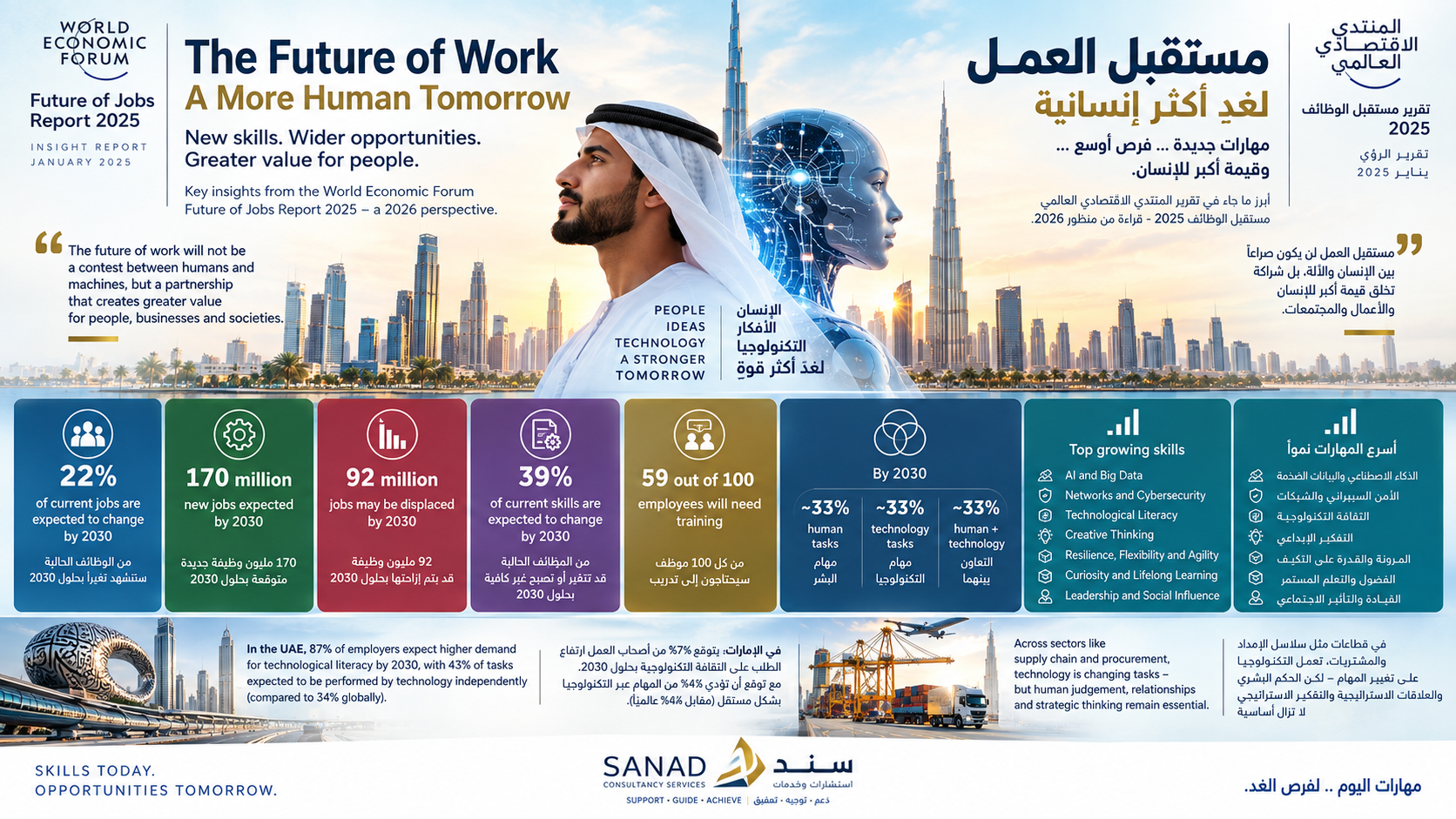
Published in January 2025, the report brings together the views of more than 1,000 employers representing over 14 million workers across 55 economies and 22 industry clusters. It estimates that structural labour-market transformation by 2030 will affect the equivalent of 22% of today’s jobs. Around 170 million new jobs are expected to be created, while 92 million are expected to be displaced, resulting in a net increase of about 78 million jobs.
These figures challenge the simplistic narrative that technology will simply eliminate work. A more accurate reading is that work is being reshaped. Some roles will decline, others will emerge, and many existing jobs will remain but require a different mix of capabilities.
The real question is no longer: will AI take our jobs? It is: how will the job change, and what skills will make people more valuable when they work alongside technology?
Jobs are changing, but skills are changing faster
One of the report’s most important insights is that disruption is not only happening at the level of job titles. Much of the change is happening inside the job.
The report expects 39% of workers’ core skills to change by 2030. If the global workforce were represented by 100 people, 59 would need training before the end of the decade. Of those, 29 could be upskilled in their current roles, 19 could be reskilled and redeployed elsewhere, while 11 may not receive the training they need.
This is not just a training statistic. It points to a deeper responsibility for both organizations and individuals. An organization that invests in technology without investing in people may acquire advanced tools without building better performance. An employee who assumes their skills can remain unchanged may find that their job has not disappeared, but it now demands something different.
Technology is rising, but human skills are not disappearing
It is no surprise that technology skills are prominent in the report. AI and big data, networks and cybersecurity, and technological literacy are among the fastest-growing skills.
What matters is that these skills do not stand alone. They are accompanied by creative thinking, resilience, flexibility, agility, curiosity, lifelong learning, leadership and social influence. Analytical thinking also remains one of the most important core skills identified by employers.
This is the key message: the future employee is not technical instead of human. The future employee combines both.
Professional value will not be measured only by the ability to use a digital tool. It will also depend on understanding context, asking better questions, assessing outputs, making responsible decisions and working with others in a faster and more complex environment.
From human versus machine to human with machine
One of the strongest ideas in the report is the changing distribution of tasks between people and technology. At the baseline of the 2025 report, employers estimated that 47% of tasks were performed mainly by humans, 22% by technology, and 30% by a combination of both. By 2030, they expected this distribution to become far more balanced: roughly one-third human, one-third technology, and one-third human-technology collaboration. These are respondents' projections, not observed outcomes for 2026.
This changes the whole frame. The issue is not always direct replacement. In many cases, the question will be: how do we design work so that technology strengthens human capability rather than simply removing the human role?
Technology can analyse large volumes of data quickly. But it does not carry professional responsibility for a decision. It can produce a draft, recommendation or comparison, but it does not always understand institutional context, relationships, risk appetite, reputation or the local environment.
Perhaps the story of 2030 is not human versus machine. Perhaps the real story is human with machine.
What does this mean for employees in the UAE?
For the UAE, this discussion is especially relevant. UAE-based respondents in the WEF report expect digital expansion, climate-change adaptation and emissions reduction to be among the forces shaping business models through 2030.
The report also indicates that the share of tasks expected to be performed autonomously by technology in the UAE could reach 43% by 2030, compared with around 34% globally. At the same time, 87% of UAE respondents expect demand for technological literacy to increase, alongside AI and big data, cybersecurity, leadership and social influence.
This does not mean that every employee must become a programmer or data scientist. Employees will need to build the following capabilities:
- Understand technology and use it effectively.
- Critically evaluate its outputs and apply sound judgement.
- Develop capabilities that require human context and judgement, including leadership, communication and adaptability.
In an environment such as the UAE, where digital transformation, energy transition, sustainability, government innovation and private-sector modernization are accelerating, the critical skill is not simply using technology. It is using it responsibly inside an institutional context.
A procurement and supply chain example
In the Supply Chain and Transportation industry, respondents expect 37% of skills used on the job to change by 2030. The report also records that 57% of employees in the industry had completed training programmes. These figures describe the industry surveyed, rather than procurement alone.
This shift is easy to see in procurement and supply chain. These functions have always relied on data, comparisons, contracts, supplier management, risk and compliance. They are therefore among the areas that can benefit significantly from analytics and AI-enabled tools.
If AI can analyse spend, compare bids, detect early risk signals, prepare a contract draft and monitor supplier performance, what remains for the procurement professional?
The answer is not: less value. The better answer is: different value.
- Commercial judgement
- Advanced negotiation skills
- Strategic supplier relationship management
- Complex risk decisions
- Strategic thinking and leadership
- Ethics and institutional accountability
Technology may move part of procurement work away from manual execution and towards analysis, guidance and decision support. At its best, this makes procurement more strategic, not less relevant.
The report distinguishes automation from augmentation: technology can execute tasks, while also being designed to strengthen human capability. The outcome depends on how organizations redesign roles, review outputs and retain responsibility for decisions.
What should organizations do now?
The practical question for organizations is not only: what technology should we buy?
The more important question is: what human capabilities do we need to build around this technology?
Organizations that want to benefit from AI need more than a software licence or a new platform. They need clear usage principles, risk controls, ongoing training, a culture that supports experimentation and learning, and leadership that understands digital transformation as a change in how work is done, not only as a technology project.
They also need to treat training as part of strategy, not as a side activity. If a large share of skills will change by 2030, capability-building must start now, before the gap becomes visible and expensive.
Consider a practical example: an AI-enabled system may rank supplier bids by price, lead time and performance indicators. Yet the lowest-priced offer may carry supply continuity risks, restrictive payment terms or dependence on a single source. The procurement professional adds value by interpreting the comparison, checking its assumptions, negotiating terms and balancing cost, quality and continuity. This is SANAD’s illustrative application, not a tested outcome reported by the WEF.
“As repetitive tasks move to technology, people gain more space for understanding, judgement, relationships and responsibility.”
Conclusion: human value is not disappearing. It is moving.
The future of work is not waiting for 2030. It has already begun.
For employees, the question is not only: will my job remain? It is: which parts of my work will change, and what skills should I start building now?
“The essential question for organizations today: what technology will we buy, and what human capabilities and skills will we build around it?”
In the end, the real story does not appear to be the replacement of people. It is the redefinition of human value. The more technology becomes capable of executing tasks, the more important it becomes to have people who can exercise judgement, learn continuously, lead others and carry responsibility.
True readiness for the future may therefore lie neither in fearing AI nor in glorifying it, but in building human capability that knows how to work with it consciously and confidently.
Preparation can start with a simple step: identify one repetitive task that technology could improve, one human capability to develop, and a learning plan to apply at work. Organizations can connect these steps to training, supervision and impact measurement. Investment in tools delivers more value when accompanied by systematic investment in people.
The figures reflect survey findings and projections published in 2025, not measured outcomes for 2026. Job transformation estimates cover economic, technological, demographic and environmental forces; they should not all be attributed to AI alone.
References