
In procurement, we often use the word strategy very easily: “We have a sourcing strategy.” “We have a category strategy.” “We have a procurement strategy for next year.”
But sometimes, when we look closely at what sits behind the word strategy, what we actually have is a plan.
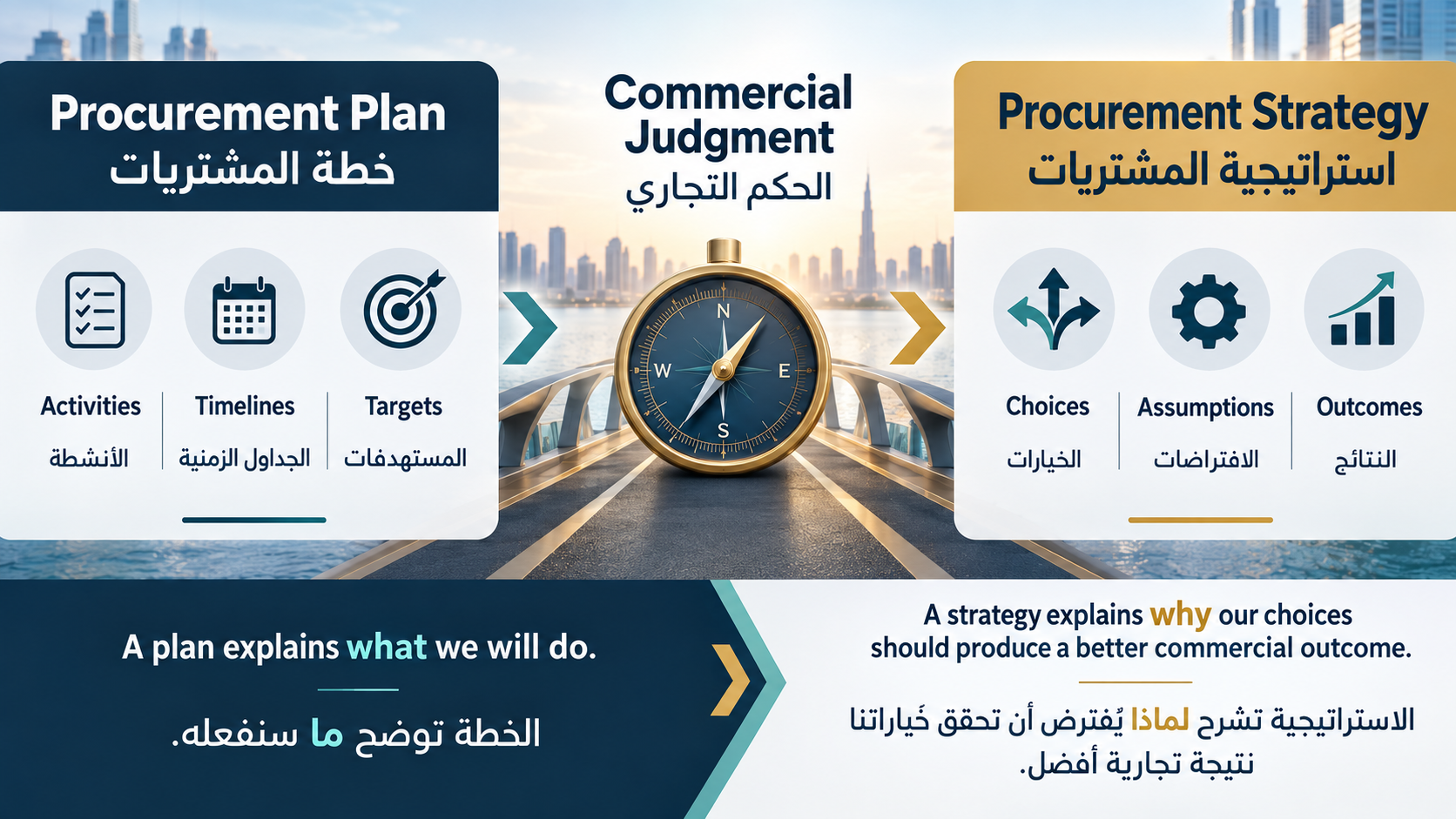
A recent Harvard Business Review video by strategy expert Roger Martin, “A Plan Is Not a Strategy,” offers a useful distinction. A plan describes what we intend to do. A strategy explains the choices we are making, why we are making them, and how those choices are expected to produce a better outcome.
“A procurement plan tells us what we are going to do. A procurement strategy explains why those choices should produce a better commercial outcome.”

What Does a Procurement Plan Look Like?
- Tender the facilities management contract in Q2.
- Consolidate the supplier base.
- Negotiate a 5% cost reduction.
- Implement supplier performance reviews.
- Introduce a new sourcing system.
- Increase local supplier participation.
- Renegotiate contracts before expiry.
Collectively, however, these actions do not automatically constitute a procurement strategy. They primarily tell us what we intend to do.
- Why are we doing it, and what problem are we trying to solve?
- What choices are we making, and what alternatives have we rejected?
- What needs to be true for our approach to succeed?
- How will these choices create better commercial outcomes for the organization?
From Activities to Choices
““We will consolidate five suppliers into two suppliers to achieve volume discounts.””
That may sound reasonable, but commercial judgment requires us to go further. Why two suppliers? What additional leverage will consolidation create? Will the expected savings outweigh greater dependency? Could consolidation reduce competition at renewal? What happens if one supplier fails? Could regional or operational requirements make a larger supplier base more appropriate?
“The strategic question is not simply, “How do we consolidate suppliers?” It is, “What supplier-market structure gives the organization the best balance of cost, capability, competition, resilience, and performance?””
The first question produces an activity. The second requires a choice.
The Comfort of Planning
Organizations can drift toward planning because plans feel controllable. Procurement can control when an RFP is issued, establish evaluation criteria, schedule negotiations, set targets, and create supplier-performance dashboards.
Many factors that ultimately determine commercial success sit outside procurement’s direct control. We cannot control whether the supplier market will remain competitive, guarantee commodity prices, prevent every disruption, or simply instruct suppliers to innovate. Transferring a risk contractually does not necessarily mean the underlying business risk has disappeared.
“Strategy requires making choices under uncertainty. That is where commercial judgment becomes important.”
Lowest Price Is a Plan. Value Requires Strategy.
A target to reduce purchase price by 10% is measurable and easy to understand. But what if it increases maintenance cost, operational downtime, or supplier fragility? What if the lowest-cost solution creates greater lifecycle cost over the next ten years?
“Commercial strategy asks what combination of price, lifecycle cost, risk, quality, service, and supplier capability creates the strongest overall outcome.”
This is why procurement strategy cannot be reduced to a savings target. Savings may be an outcome. They are not, by themselves, a strategy.
Risk Transfer Is Another Good Example
Contracts often attempt to transfer risk to suppliers, and sometimes that is appropriate. But transferring every possible risk is not necessarily good commercial management. The better question is which party is best able to understand, manage, and control each risk.
- Increase its price or build contingency into the contract.
- Refuse to bid.
- Accept the risk but later struggle to perform.
- Seek to recover the cost through claims and variations.
The contract may appear to protect the buyer while creating a poorer commercial outcome. Commercial judgment means allocating risk deliberately rather than simply transferring it.
Strategy Requires a Theory
One of the most useful ideas in Roger Martin’s explanation is that strategy contains a theory. In business strategy, management develops a view about where to compete and how the organization can succeed. Procurement needs similar thinking.
“We believe that consolidating demand across business units will create sufficient purchasing leverage to secure improved commercial terms without creating unacceptable supply-continuity risk.”
That is a strategic hypothesis, and it can be tested. Is the demand genuinely similar enough to aggregate? Does volume influence supplier pricing in this market? How concentrated is the market? What switching costs exist? How dependent would we become on the selected suppliers? What must be true for the assumption to work?
The One-Page Test
Remove the timelines, tender schedules, action trackers, and presentation slides for a moment. Can you explain the strategy on one page?
- Where are we focusing, and what commercial outcome are we trying to achieve?
- What choices are we making, and why do we believe they will work?
- What capabilities do we need?
- What assumptions must be true?
- What risks could invalidate those assumptions?
- How will we know whether the strategy is working?
If those questions cannot be answered, we may have a very detailed procurement plan, but not yet a procurement strategy.
From Procurement Administration to Commercial Judgment
Good procurement administration remains essential. Governance, competition, documentation, and compliance matter. But these are foundations. Greater value comes when procurement professionals use those foundations to make sound commercial choices.
- Why this approach, supplier model, pricing mechanism, and risk allocation?
- Why this contract duration and evaluation model?
- What evidence supports our recommendation?
“Knowing the difference between a plan and a strategy is an important part of moving from procurement administration to commercial judgment.”
Reference
SANAD Consultancy Services (FZE) Support · Guide · Achieve