

Someone loves perfume. They follow new releases, can distinguish different scents, and friends often ask for recommendations. One day a thought occurs: “Why not launch my own fragrance brand?”
It could become a successful business. Yet a love of perfume alone cannot answer the questions that follow: Who will buy it? Why choose this brand among existing ones? What will each bottle cost after production, packaging, marketing, and delivery? How many must be sold before expenses are covered?
“Passion sparks the beginning; business discipline sustains the journey.”
There is no magic formula for success. The idea can, however, be tested and better decisions made before it turns into financial commitments.
Start with the customer, not the business name
Before choosing a name, logo, or location, describe the offer clearly. Who is the customer? What do they need? How will you meet that need in a way they value?
An entrepreneur does not need to master every task, but should understand the basics of the product, quality, cost, pricing, and operations. Specialists, managers, and advisers can help. That understanding lets the founder assess their work and make decisions. When the field is new, learning and a limited trial should come before a large investment.
A familiar idea can work if customers see the difference
The idea does not have to be entirely new. A market with many competitors may also have proven demand. But a near-identical offer leaves customers asking: Why should I buy from you?
Study direct competitors and the alternatives customers already use. Compare price, quality, ease of purchase, delivery, and after-sales service. Speak with potential customers about what they like and what they wish were better.
Your difference may be a specialism for a defined group, consistent quality, dependable speed, or a simpler buying experience. It becomes a real advantage when customers value it, you can deliver it consistently, and it leaves a profit. Cutting price without knowing cost can bring orders and losses at the same time.
Test the idea before building large expectations
Praise from friends is not confirmed demand. A stronger test offers the product or service to real customers and observes who buys, what price they accept, and whether they return.
A trial may reveal that customers want another size, an added service, or an easier way to sample and buy. That insight is valuable before signing a long lease or purchasing substantial stock. If demand is weaker than expected, the concept or its scale can change while change is still affordable.
A feasibility study is a decision you help make
A feasibility study connects market findings to the economics of the business. What will startup cost? What are the monthly expenses? How many sales reach break-even? What if sales are lower than forecast or payment is delayed?
The founder should first gather information and understand the assumptions. A preliminary study may be enough for a small, low-cost trial. A business needing major equipment, premises, or finance may benefit from experienced market, technical, and financial specialists. In either case, the founder must be able to explain the numbers and their sources. A polished report cannot decide for them.
Support programmes show why this matters. Some Mohammed bin Rashid Fund for SMEs services require market and financial studies. The Fund says it analyses the study submitted by the applicant rather than preparing it on their behalf. Khalifa Fund asks for a business plan to assess market, technical, and financial viability, with guidance available when needed. Requirements differ by programme.
The conclusion might be to proceed, try a smaller version, target another customer group, or postpone the investment. Each is useful when supported by clear information.
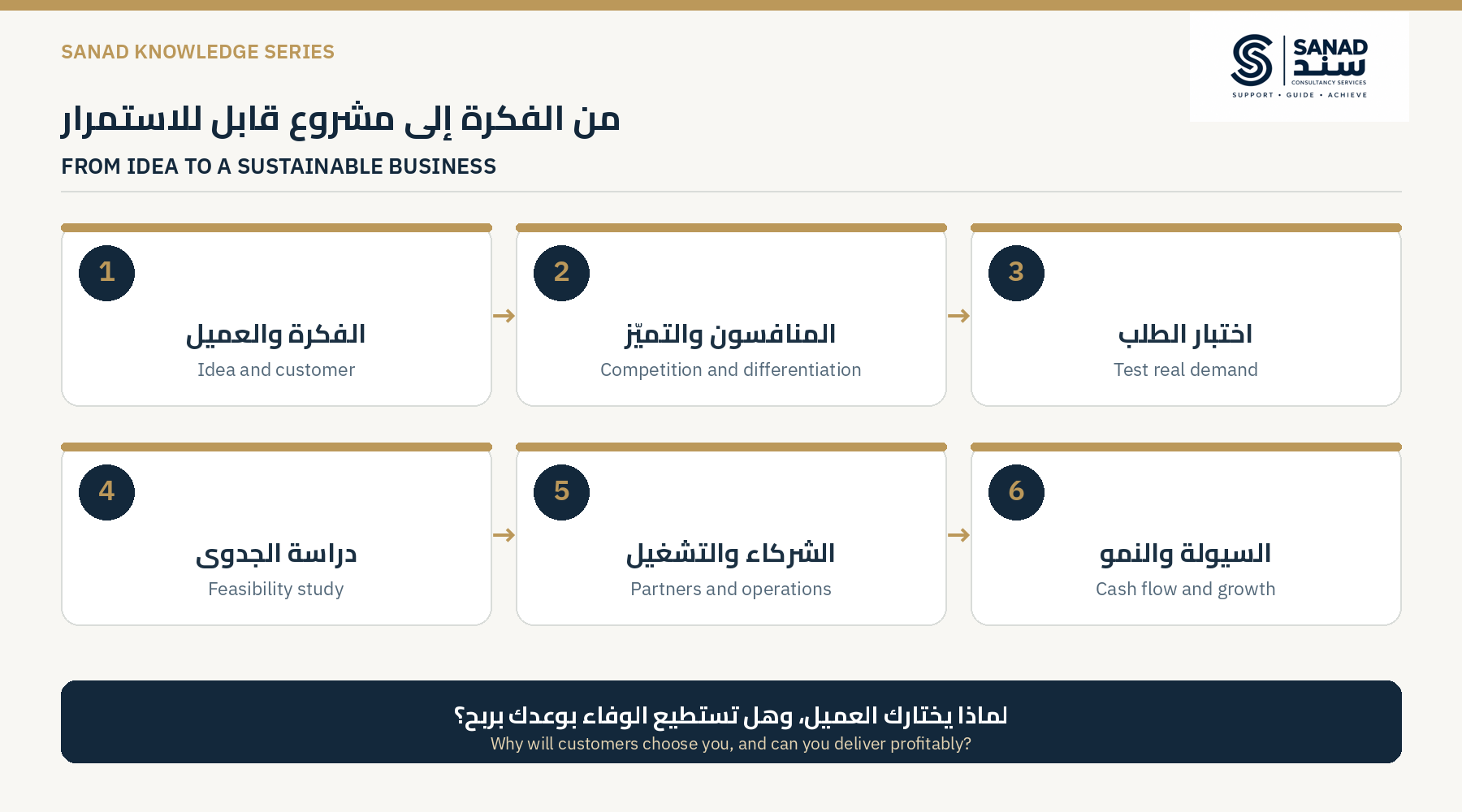
Agree with a partner before you disagree
Partners may agree on the business concept but differ on the pace of growth and spending. One wants larger premises and a full team immediately; another wants to wait for sales evidence.
Set out each person’s contribution and role, authority to buy, hire, and borrow, decisions requiring joint approval, and how disputes or exits will be handled. A clear agreement protects both the venture and the relationship.
The operating test begins after the first sale
A first purchase is not enough. Was the product delivered as promised? Was quality consistent? Did you know the cost of fulfilling the order? How was a complaint resolved?
Even a small business needs understandable records of sales, costs, orders, collections, and complaints. If someone else manages daily operations, the owner still needs performance indicators and an explanation for changes. Delegation supports growth when information and controls are clear.
The same applies when buying an existing business. A shop, staff, and customers do not prove profitability. Review its records, obligations, equipment, reasons for sale, and whether success depends on the former owner or a key employee.
Watch cash before expanding
Sales, profit, and available cash are different. A contract can show a good margin while requiring wages and purchases to be paid before the invoice is collected.
Know the cost of each product or contract, payment and collection dates, and the cash needed over the coming months. A larger branch, new equipment, and more staff raise monthly costs whether sales increase or not. Growth is stronger when it follows repeat demand, operating capacity, and sufficient liquidity.
Can employment and a business run together?
Yes, if the scale and operating model fit the time available. An employee needs defined hours outside work, someone to handle daily tasks when necessary, and a way to monitor orders, revenue, and service quality without working late every day.
They should watch the effect on their job, health, and family, and keep the employer’s time, resources, information, and commercial relationships separate from the venture. If a conflict of interest or competition may arise, review the employment contract and applicable policies. Some UAE private-sector contracts may include non-compete provisions subject to specific rules.
Resigning is not a test of seriousness. It becomes a decision worth examining when demand repeats, profit and cash are clear, and reserves can cover business and household expenses during the transition.
Mistakes you can notice early
Some ventures struggle when investment starts before the customer is understood, the competitor’s offer is copied without a meaningful difference, or the feasibility study assumes only the best case. Problems can also arise from unclear partner authority, expansion ahead of demand, a contract the business cannot finance, or operations the owner cannot monitor.
These are not inevitable causes of failure. They are signals to pause, understand what is happening, and adjust decisions before correction becomes expensive.
The decision before launch
Entrepreneurship does not suit every person at every stage, and the same idea may need a different starting approach for different founders. Its prospects improve when the founder understands the field, listens to customers, studies competitors, tests viability, and reviews operations and finances regularly.
Before asking “Do I love this idea?”, also ask: Why will customers come to me, and can I deliver on the promise profitably, again and again?
In the next SANAD article, we will look at the role of SMEs in the UAE economy and how government entities and major companies can help them access market and contract opportunities.
References
- US Small Business Administration — Plan your business and research the market
- Mohammed bin Rashid Fund for SMEs — Credit and loan requirements
- Mohammed bin Rashid Fund — Consultation and feasibility analysis
- Khalifa Fund — Business plan and advisory FAQs
- UAE Government — Employment contracts and non-compete provisions
SANAD Consultancy Services (FZE) Support · Guide · Achieve